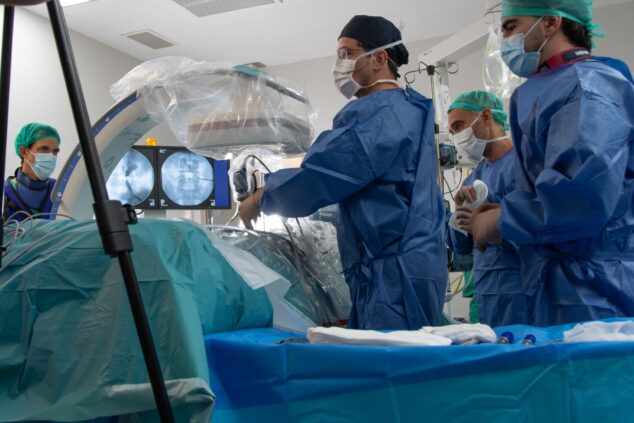
The University Hospital of Dénia has broadcast live two minimally invasive endoscopic spine surgeries, performed at its facilities, during the pre-congress course of the 3rd edition of the Congress of the Society Spanish Society of Percutaneous and Endoscopic Spinal Surgery (SECPEC). More than one hundred national and international specialists were able to follow these procedures from Valencia, which demonstrated various applications of this technique for the treatment of spinal pathologies.
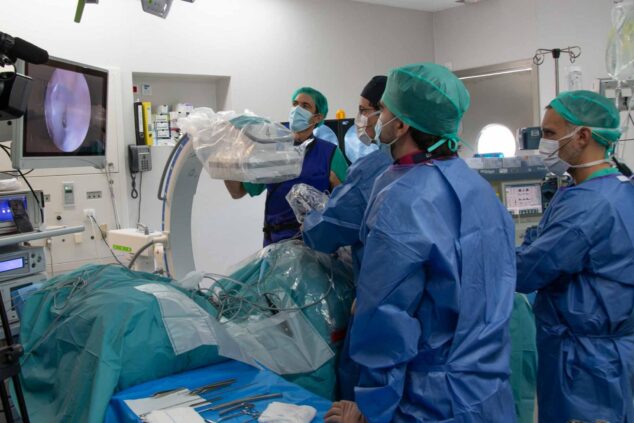
The Dénia Hospital incorporated endoscopic spine surgery in 2017being the first center in the Valencian Community to introduce this technique. The Traumatology and, later, the Neurosurgery departments have developed these procedures and have actively participated in the creation and operation of the Spanish Society of Percutaneous and Endoscopic Spine Surgery (SECPEC).
Success in live-streaming surgeries
The Organizing Committee of the meeting, held at the City of Arts and Sciences in Valencia, was chaired by the traumatologist from the Hospital of Dénia, José Lizón AguilarHe highlighted that one of the main attractions of the pre-congress is "the possibility of seeing live surgical procedures and learning firsthand how these minimally invasive techniques are developed."
Details of the surgical procedures
The first procedure was an endoscopic decompression for lumbar spinal stenosis. Specialists removed the tissue responsible for the nerve compression through two small incisions, an approach that minimizes damage to muscles and soft tissues.
The second surgery addressed vertebral instability through a lumbar fusion, also assisted by endoscopy. In this procedure, an interbody cage and fixation systems were implanted to stabilize the affected vertebrae, using endoscopic visualization to minimize tissue damage.
Advantages of the minimally invasive technique
Endoscopic spine surgery currently allows the treatment of around 80 % of the most frequent spinal pathologies. These include herniated discs, spinal stenosis, and certain vertebral instabilities. Its main advantages include less invasive surgery, less postoperative pain, a significant reduction in hospital stay, and a faster functional recovery. In many cases, patients can be discharged on the same day as the procedure or the following day. The technique uses cannulas of barely 8 mm o 1 centimeter in diameter to access the spine and reduce damage to muscles and soft tissues.
The Third Biennial Congress of the SECPEC
The 3rd SECPEC Biennial Congress has brought together approximately 130 surgeons Specialized in spinal surgery. Furthermore, 50 Professionals enrolled in the prior practical course, dedicated to learning endoscopic techniques on anatomical models.